Pharmaceutical
Pharmaceutical Excipients: A Sourcing Guide
A function-first guide to tablet excipients — fillers, binders, disintegrants and lubricants — and how to specify the right compendial grade and documentation.

By Berstin Technical Desk · Sourcing & Technical Specialists
· 4 min read
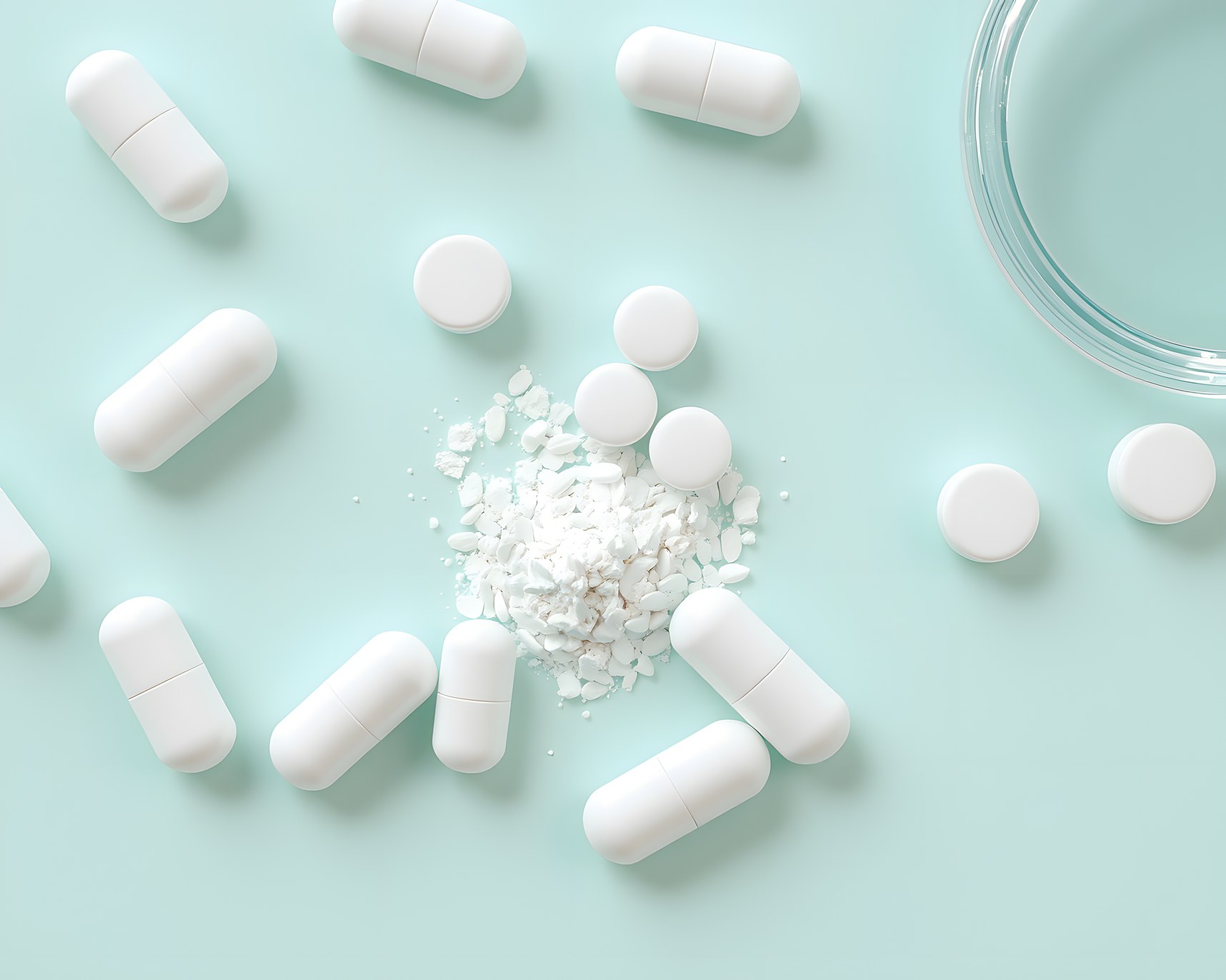
Choosing pharmaceutical excipients is a function-first decision, not a shopping list. Every excipient earns its place by doing a job — adding bulk, binding granules, helping a tablet break apart, or keeping powder flowing through the press — and the same job can be met by several materials at several grades. This guide maps the common tablet excipients to their functions and then to what you actually need to specify when you buy them.
What are pharmaceutical excipients?
Pharmaceutical excipients are the functional, non-active ingredients in a drug product — everything other than the active pharmaceutical ingredient (API). They include diluents/fillers, binders, disintegrants, lubricants and glidants, and their role is to deliver the active ingredient reliably: to make the dose manufacturable, stable and able to release as intended. Sourcing them means matching each excipient’s function to your formulation and then specifying the right compendial grade (USP/EP/JP) with the quality documentation your filing requires.
Quality standards for excipients are published as monographs. In the United States, excipient monographs sit in the National Formulary section of the combined USP-NF, while in Europe the European Pharmacopoeia (Ph. Eur.), maintained by the EDQM, sets the official standards used in the manufacture of medicines and their ingredients.
What are the main types of excipients in a tablet?
A conventional immediate-release tablet is built from a small number of functional classes, and most formulations use one or more from each:
- Diluents / fillers provide bulk so a low-dose active can be compressed into a handleable tablet.
- Binders give the granules and the finished tablet cohesion so it holds together.
- Disintegrants and superdisintegrants make the tablet break apart in aqueous fluid so the active can dissolve.
- Lubricants reduce friction between the tablet and the press tooling and prevent sticking.
- Glidants improve powder flow into the die.
Many excipients are multifunctional, so the same material can appear under more than one heading depending on how it is used.
Which excipient does which job?
The table below maps the six excipients in Berstin’s pharmaceutical catalogue to their primary function. Treat it as a directional guide to roles, not a specification — exact functional behaviour depends on the grade.
| Excipient | Primary function | Note |
|---|---|---|
| Microcrystalline cellulose (MCC) | Filler / binder | Dry binder; widely used for direct compression |
| Lactose monohydrate | Diluent | One of the most common tablet fillers |
| Mannitol | Diluent | Common in chewables/ODT; non-hygroscopic |
| Magnesium stearate | Lubricant | Reduces sticking to press tooling |
| Croscarmellose sodium | Superdisintegrant | Promotes rapid tablet break-up |
| Crospovidone | Superdisintegrant | Promotes rapid tablet break-up |
Functional roles are general pharmaceutics knowledge. Confirm exact properties, grade and acceptance criteria against the current TDS/SDS and CoA for the grade you are sourcing.
Microcrystalline cellulose (MCC) is a workhorse filler that also acts as a dry binder, which is why it features heavily in direct-compression formulas. Lactose monohydrate is one of the most common diluents, valued for predictable compaction and cost. Mannitol is a non-hygroscopic diluent often chosen for chewable tablets and orally disintegrating tablets (ODTs). Magnesium stearate is the standard lubricant, added to keep the blend from sticking to the tooling. For disintegration, croscarmellose sodium and crospovidone are superdisintegrants that pull water in and help the tablet break apart quickly.
You can see live trade names and availability for these and related materials on the Berstin product portfolio, and the detail page for microcrystalline cellulose shows how a single excipient is offered across grades.
What grade and documentation should you specify?
The decisive part of an excipient order is not the name — it is the grade and the paperwork. Excipients are generally available to compendial grades (USP/EP/JP), but the same excipient name can ship at different specifications, and functional properties differ accordingly. So the specification you write, not the material itself, defines what arrives.
When you raise an enquiry, specify:
- The compendial grade required (USP/EP/JP) and any harmonised standard your market relies on.
- The documentation set your filing needs — Technical Data Sheet, Safety Data Sheet and a batch Certificate of Analysis (CoA).
- The function and dosage form the excipient serves (for example, a non-hygroscopic diluent for an ODT) so the right grade is matched.
Do not assume a given grade is “USP compliant” until it is confirmed against the current TDS/SDS and CoA. In the United States, the FDA’s Inactive Ingredient Database records inactive ingredients present in approved drug products and is used by formulators as an aid during development; it is a reference tool, not a substitute for grade-level documentation.
How to source pharmaceutical excipients reliably
Reliable excipient sourcing comes down to four steps: define the function each excipient must perform, choose candidate materials for that function, specify the compendial grade and documentation, and qualify the supply chain that delivers them. An independent distributor adds value at the last two steps — matching the right grade from the right manufacturer to your specification, with the lead time, indicative pricing and documentation your market requires.
Berstin supplies pharmaceutical excipients — including microcrystalline cellulose, lactose monohydrate, mannitol, magnesium stearate, croscarmellose sodium and crospovidone — from a curated network of named manufacturers. Tell us the function, the compendial grade and your destination market, and we will respond with documentation, lead times and indicative pricing.
Frequently asked questions
What are pharmaceutical excipients?
What are the main types of excipients in a tablet?
What grade and documentation should I specify when sourcing excipients?
What makes a reliable excipient supplier?
Materials referenced
Materials covered in this article — talk to us for grades, specs and availability.
Personal Care
Microcrystalline Cellulose (MCC)
Pharmaceutical
Lactose Monohydrate
Pharmaceutical
Mannitol
Pharmaceutical
Magnesium Stearate
Pharmaceutical
Croscarmellose Sodium
Pharmaceutical
Crospovidone
Sources
Related articles
Glycerine Grades: USP vs Technical Explained
Technical, food-grade E422 and USP/EP pharmaceutical glycerine share one molecule but differ in purity, impurity limits and paperwork — here is how to pick and specify the right tier.
SLES vs SLS vs CAPB: Choosing the Right Surfactant
How SLES, SLS and cocamidopropyl betaine differ on mildness, foam and cost — and how formulators pair a primary and a secondary surfactant in real products.
APG: The Natural, Biodegradable Surfactant
What alkyl polyglucosides are, why they read as natural and biodegradable, and how decyl, lauryl and coco glucoside differ for formulators and buyers.